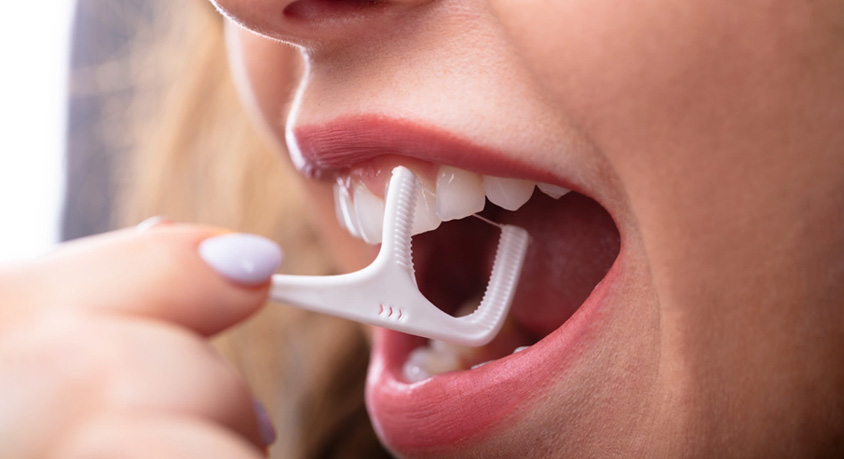
You finish dinner. A piece of spinach is stuck between your back teeth. You reach for a dental floss pick—a small plastic handle with a curved arm holding a single strand of floss. You snap it in, wiggle out the food, and rinse the pick under the tap.
E.g. :You Brush Horizontally – That Motion Is Carving Grooves Into Your Teeth
- 1、The “One Pick, Many Teeth” Myth
- 2、Why Reusing Is Worse Than Not Flossing
- 3、The Hidden Design Flaw of Floss Picks
- 4、What You’re Actually Transferring Between Teeth
- 5、How to Clean Between Teeth Correctly
- 6、A Simple Test: Smell Your Used Floss Pick
- 7、FAQs
You put it back in the drawer. Why waste a perfectly good pick? You’ll use it again tonight.
That little habit—reusing a floss pick—is doing something you never imagined. Each time you insert that same pick into a different gap, you’re transplanting bacteria from yesterday’s plaque into today’s clean gum pockets.
The “One Pick, Many Teeth” Myth
Most people assume that rinsing a floss pick under water removes bacteria. It doesn’t. Water alone cannot dislodge the sticky biofilm (dental plaque) that clings to the floss strand.
A 2018 study in the Journal of Clinical Dentistry examined used floss picks under a microscope. After a single use, the floss strand carried an average of 10⁵ to 10⁶ colony-forming units of bacteria—including Streptococcus mutans (cavity-causing) and Porphyromonas gingivalis (periodontitis-associated). Rinsing reduced the count by less than 5%.
When you reuse that pick, you transfer that bacterial load directly into the next interdental space. Different tooth surfaces have different bacterial communities. You’re effectively cross-contaminating your entire mouth.
Why Reusing Is Worse Than Not Flossing
You might think: “Something is better than nothing.” But with floss picks, reusing may be worse than skipping.
Not flossing leaves bacteria in place. Reusing a contaminated pick introduces foreign bacteria into a gap that might have had a different, less aggressive microbial profile. This can trigger localized inflammation or even shift the balance toward more pathogenic species.
A 2020 study in Oral Health & Preventive Dentistry compared three groups over four weeks: those who used a new floss pick per gap, those who reused one pick for all gaps, and those who didn’t floss. The reuse group had higher gum bleeding scores than the non-flossing group. The cross-contamination caused more inflammation than doing nothing.
The Hidden Design Flaw of Floss Picks
Dental floss picks are convenient. But that convenience comes with two engineering problems:
Short Floss Segment
A pick uses about 1 inch of floss. With regular string floss, you wind fresh floss around your fingers and advance to a clean section for each tooth. With a pick, the same 1-inch segment touches every gap. Bacteria, food debris, and even blood from inflamed gums sit on that short strand, moving from tooth to tooth.
Reusable Handle, Single-Use Intent
Floss picks are labeled as single-use devices. The plastic handle is reusable, but the floss degrades after one insertion—it frays, loses tension, and becomes less effective at removing plaque. Most people ignore this and keep using the same pick for days or weeks.
A 2019 survey in the Journal of Dental Hygiene found that 63% of floss pick users reused the same pick at least three times. Only 12% replaced it after every use.
What You’re Actually Transferring Between Teeth
Think of each interdental space as a unique ecosystem. The bacteria living between your lower left premolars differ from those between your upper right molars.
When you reuse a pick, you transfer:
- Live bacteria that survive drying and rinsing.
- Endotoxins from bacterial cell walls, which trigger inflammation.
- Blood-borne pathogens if any gap was bleeding.
A 2021 laboratory study in Infection and Immunity tested bacterial transfer via reused floss picks. After five passes between different artificial gaps, the floss carried detectable DNA from every previous gap. The authors concluded that reused picks act as “shuttles for oral microbial exchange.”
How to Clean Between Teeth Correctly
You don’t have to abandon convenience. But you do need to change how you use these tools.
Use a Fresh Pick for Every Single Use
Treat floss picks like tissues: one use, then discard. Buy picks in bulk to keep costs low. A box of 150 picks costs roughly the same as one cavity filling.
Switch to String Floss
Standard floss allows you to unwind a clean segment for each tooth. Use about 18 inches, wrap around your middle fingers, and advance 1–2 inches between gaps. This completely eliminates cross-contamination.
Try Interdental Brushes
For gaps that are wider (most gaps between molars and premolars), interdental brushes are more effective than floss and naturally single-use. Rinse the brush after each gap, but use a new brush each day. A 2020 meta-analysis in the Journal of Clinical Periodontology found that interdental brushes remove 2.5 times more plaque than floss.
Water Flossers: A Clean Alternative
Water flossers use a fresh stream of water for every gap. No cross-contamination. They are especially useful for people with bridges, implants, or orthodontic braces.
A Simple Test: Smell Your Used Floss Pick
After you use a floss pick, smell it. If you notice a foul, rotten odor, that’s volatile sulfur compounds—the same chemicals responsible for bad breath. That odor means you’ve just removed bacteria-laden plaque. Rinsing won’t remove that smell, and neither will it remove the bacteria.
If you wouldn’t put that pick in your mouth again after smelling it, don’t.
FAQs
Q: Can I disinfect a floss pick with alcohol or boiling water?
A: Boiling water melts the plastic. Alcohol wipes may reduce surface bacteria but cannot penetrate the microscopic grooves in the floss strand. Even after disinfection, the floss frays and loses its cleaning efficiency. It’s simpler and safer to use a new pick every time.
Q: What if I only reuse the pick on the same gap (e.g., a single tight spot)?
A: Reusing on the same gap is less risky than moving between gaps, because you’re not cross-contaminating. However, the floss still degrades and collects bacteria from that one spot. Replace it daily. For a single difficult gap, consider an interdental brush or a water flosser instead.
Q: Are floss picks better than nothing for people who won’t use string floss?
A: Yes, if used correctly—one pick per use, disposed after. For people who refuse to use string floss, a fresh floss pick each day (used on all gaps) is still better than no cleaning. But the ideal is a fresh pick for each gap or switching to string floss. The “reuse” habit is what causes harm.